A MISCHIEF OF MAGPIES: SCREENRANT INTERVIEW
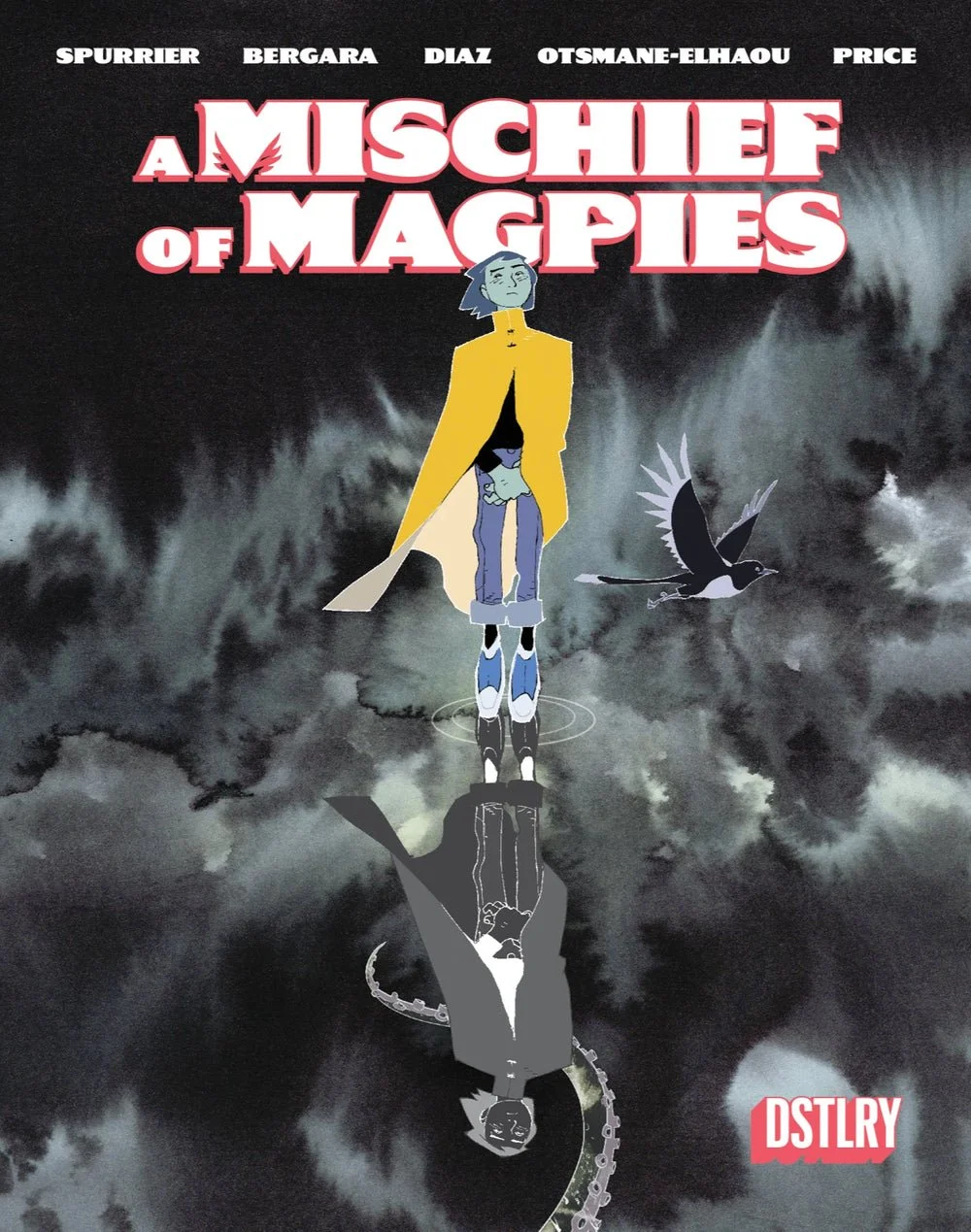
Cover A - Matias Bergara
To celebrate the imminent arrival of A MISCHIEF OF MAGPIES #1, my co-creator Matias Bergara and I did an interview with SCREENRANT.
In the event they loved the series so much they turned the article into a deliciously gushing review, with just a few excerpts of the interview embedded.
With their permission, we thought it would be nice to run the full interview here, since it sheds a lot of light on the complex behind-the-scenes process. More than any other book I’ve worked on, AMOM exemplifies the importance of collaboration in this magical medium of comics. We simply couldn’t have done this book without every member of the team pulling their weight, and working cohesively as a single creative entity. Enjoy!
[A MISCHIEF OF MAGPIES #1 DROPS JULY 15TH]
SCREENRANT: Si, A Mischief of Magpies is a very unique and moving story, and one that I think is really going to resonate with readers. What was the genesis for it? Was there a particular “a-ha!” moment that brought it together?
SPURRIER: Okay, let me start with the finished product then twitch back the curtain on how it got made.
AMOM’s a portal fantasy about a crisis-riddled teenager who starts falling out of reality. He reappears in an insane city, built upon a colossal machine, chugging endlessly across a waterworld. The city’s divided between the bright spires of its upper levels and the monster-haunted caverns below the waves. Our hero sets out to explore. Trying to understand why him, and why here? Most importantly, trying to work out how he can escape from his own sucky life and stay in the fantasy forever. Along the way he discovers a secret at the core of the Wandering City, which sends ripples through both worlds he inhabits…
Intriguing, right…? So: how did we come to tell this weird tale? Well, in multiple ways, but the biggest factor speaks to the nature of collaboration itself.
In my view, comics are the most beautifully engineered expression of “many heads better than one”. At their best, when every part of the creative team is engaged and excited, comics become far more than the sum of their parts. But they also manage to avoid the opposite pitfall – “too many cooks spoil the broth” – which is often the case with bigger, more corporate media.
I’ve been lucky enough to work with Matías multiple times. When you hit on a collaboration that works, you cling to it. Partly for pragmatic reasons, sure (it becomes a brand; people will get excited for a new “Spurgara” book without knowing anything about it) but moreso because it makes us do our best work. We could just keep producing exactly the same sort of stuff over and over. Plenty of well known writer/artist team-ups do just that. But my sense is, if you’re going to work in genre, push it. If you’re going to work with the same team, keep levelling up. Resting on laurels is creative death.
Our first creator-owned collaboration, Coda was about putting fantasy cliches out of their misery. Our next, Step By Bloody Step, was about emotionally powerful storytelling in the absence of language. When we came to do our third book it wasn’t just a case of “I’ve got an idea,” it was also a question. “What experiments do we want to conduct, and what stories would let us conduct them?”
The “ah-ha!” moment you mention is precisely what you get, in this sort of situation. Form and function clicking together. We quickly hit on the idea of trying to create a book that feels like a cocktail of storytelling methods. I love words, I love prose, I love illustrated books, and of course I love comics. I’ve never yet seen a really good example of a satisfying blend of these things, done in a way that feels effortless. All too often it’s just “comicbook with heavy text interludes”, which can be jarring (how many of us just hit the mental “skip” button?) or “picture book with a few comics panels thrown in”, which can infantilize the whole thing. The closest I could get to what I had in mind would be sequential non-fiction work, like Joe Sacco’s books, or the anarchic xerox fanzines of the 80s and 90s.
The solution was twofold. First: we use the Portal Fantasy trope, in which a character switches from the real world into an alternate reality. That way we can chop-up our media to fit. Hence, in AMOM, when we’re storytelling in the fantastical world we rely on Matías’s visionary artistic talent. When we’re storytelling in the real world we let text do the talking, with illustrations to hint at what we’re not saying aloud.
How then do you avoid these transitions being jarring? The answer: a diary. We use text as a privileged peek inside the head of the protagonist. His purest, most secretive, most troubled thoughts. These can be subtly eked out – here dense, there light – segueing into and through the sequential pages. (For example: there’s a whole 25-page sequence without any text at all, at one point, when our hero has temporarily quit on his diary.)
The objective was always that the mix of media should feel organic and above all earned. When we glide subtly from comics to prose it’s because the protagonist needs to, wants to; invites us with him. The reader should be swept along without being aware of the joints.
This posed the next set of questions. What sort of person would keep a diary, while also experiencing transitions into a fantasy world? How would their story progress? What secrets can we uncover? What emotion does this invoke? I won’t speak too much to these things for fear of spoiling our tale, but - well. We landed exactly where I opened this interview: a troubled kid, dealing with some really dark challenges, who starts tumbling into a strange, beautiful, frightening alternate world.
He, like our readers, is invited to wonder why. And that becomes the story.
SCREENRANT: A Mischief of Magpies appears, to me anyway, a very “collaborative” book. How much input into each other’s creative processes did you have while working on this project?
BERGARA: In the case of this particular book we had a much more intense back-and-forward process of decisions and design because of the nature of the type of experimental narrative we chose for the story. We're mixing narration, panels, text, collage, etc - so we can't just rely on our typical method of Si-writes-first-and-then-I-draw and off it goes to lettering. We had to involve the designing and lettering and laying out of parts and panels strategically well before any art was done. Questions like "Is this gonna be alluded to in a text box in the middle of the page, or is it gonna be an image, or a mix of both?" had to be answered before and not after the art was on its way.
All of the work we do is 100% collaborative but in this occasion we could say we had to incorporate a whole new level of planning.
SPURRIER: Yeah, precisely. I like to think we make books that would otherwise be impossible for anyone who wasn’t a writer/artist doing it all solo. Here we’ve dialled that up even further, so it’s not just Matías and me working as a unit; it’s every other part of the team too. We simply couldn’t have done this book without a world-class letterer and designer (Hass Otsmane-Elhaou and Emma Price, respectively), nor if we didn’t have one of comics’ very best editors (Eric Harburn) conducting it all with orchestral finesse. Individual pages went back and multiple times, passing between many hands, sculpting, polishing, repolishing. It was far more labor-intensive than any conventional project, but I think the result pays off the effort.
SCREENRANT: What led you to bring this project to DSTLRY?
BERGARA: DSTLRY has been putting out excellent titles from creators we admire, all 100% new, creator owned titles -which is something we consider to be the best way of doing comics- and also in a special kind of "wide" format sizing that benefits certain traits of cinematic-like narration in comics.
SPURRIER: 100%, yeah. I’ll also add that I find myself increasingly drawn to publishers which make a virtue of valuing their creators.
Western comics are still very much dominated by shared universe/franchise IPs, and there’s nothing inherently wrong with that. But one problematic upshot is that for every good writer or artist who hopes to be paid a living wage to say something new and important with these beloved legacy IPs, there are a hundred fans who’d willingly do it for free. The latter can certainly produce the material, it’s just that it tends to be a retread of comfortable, familiar tales and tired themes. More damagingly, it contributes to the normalisation of lazy regurgitative content, to the extent that large parts of today’s fandoms expect and want precisely that. No change, no challenge, no power or politics. That’s the enshitifcation of comics right there, and it’s very hard to push that toothpaste back into the tube.
Luckily, editors and publishers – even some of the big ones - are increasingly recognizing that the only way to futureproof our beautiful medium, to stop it disappearing up its own cliche-riddled fundament, is to reassess the value of creators. To see us as generators of emotion and originality. Explorers of undiscovered territory. Not just Mindless Content Creators.
So when you get a publisher like DSTLRY, tacitly enfranchising creators into the financial and cultural performance of a book, people pay attention.
SCREENRANT: Matias, how did you become involved in A Mischief of Magpies?
BERGARA: Pretty much in the same way me and Simon have been starting projects: Si first pitches an idea for a new story to me, something he always does first - because I don't really have a writer's muscle and most of my storytelling skills are built on top of pre-existing concepts or plots- and then we both engage in a back and forth exchange of images and evocations and possible directions the characters and story could take. That's when the thing starts to actually come to exist. In the particular case of AMoM, Si had the basic idea of us trying to go a very different way and create a comic book with a huge presence of text and narration, in complete opposition to what we did before in Step By Bloody Step wich was to have absolutely no text or words anywhere at all. On top of that notion the story was built and the characters were outlined. Our editor Eric Harburn had a crucial role in pushing us to really explore and develop this direction for the book to the max.